Stranded is a browser-based platform for working with sequences, chromatograms, alignments, assemblies and phylogenies. One central spot for all your molecular work - import, annotate, analyse, and share without switching tools. Analyses run on our servers, so there is nothing to install and no local compute needed.
Made & hosted in the EU, and GDPR compliant!
// features
Stranded combines the core tools you need for sequence analysis in one platform:
01 - Viewer
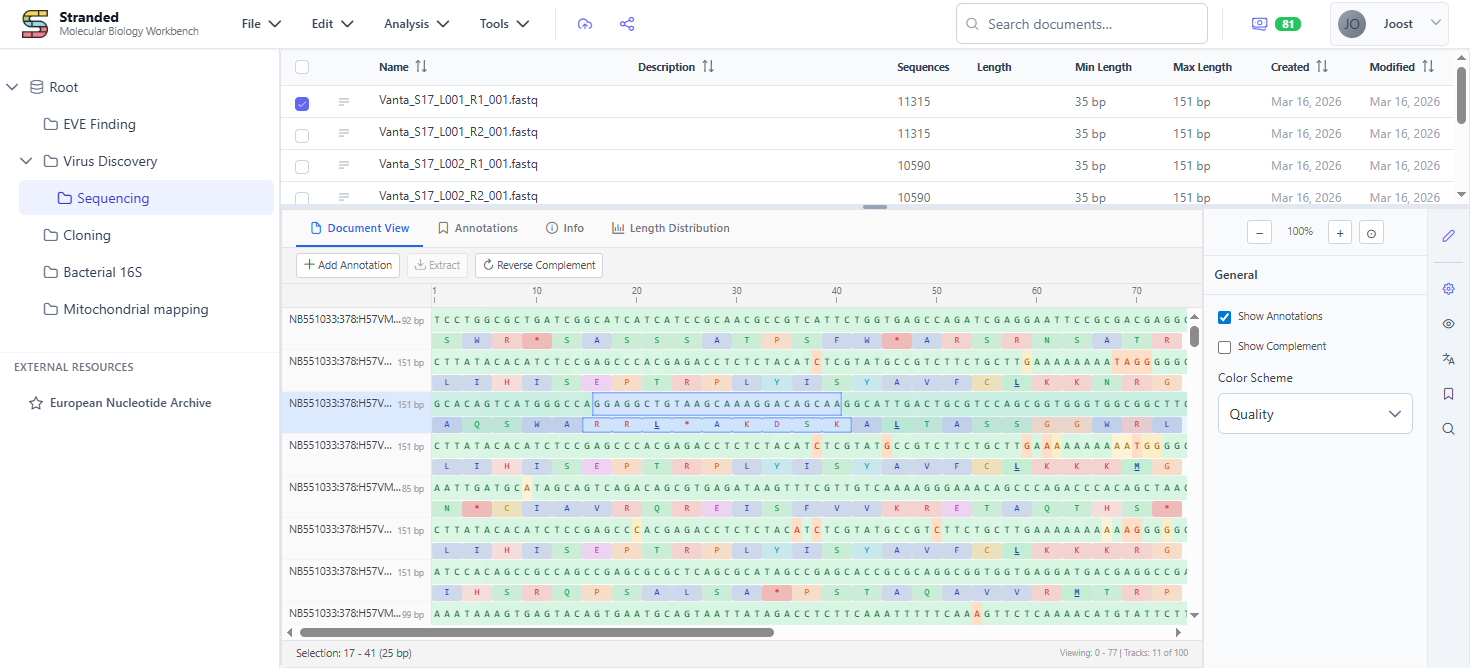
Navigate sequences with a track-based viewer. Linear maps, circular plasmid views, and raw sequence text. Toggle annotation tracks, translation frames, restriction sites, and GC content as independent layers. For NGS data, generate per-sample quality reports and apply read filtering before downstream analysis.
02 - Chromatograms
Import .ab1 files and view chromatograms with per-base quality scores. Trim ends, review ambiguous calls, easily merge multiple sanger tracers, and confirm your sequencing results.
03 - Alignment
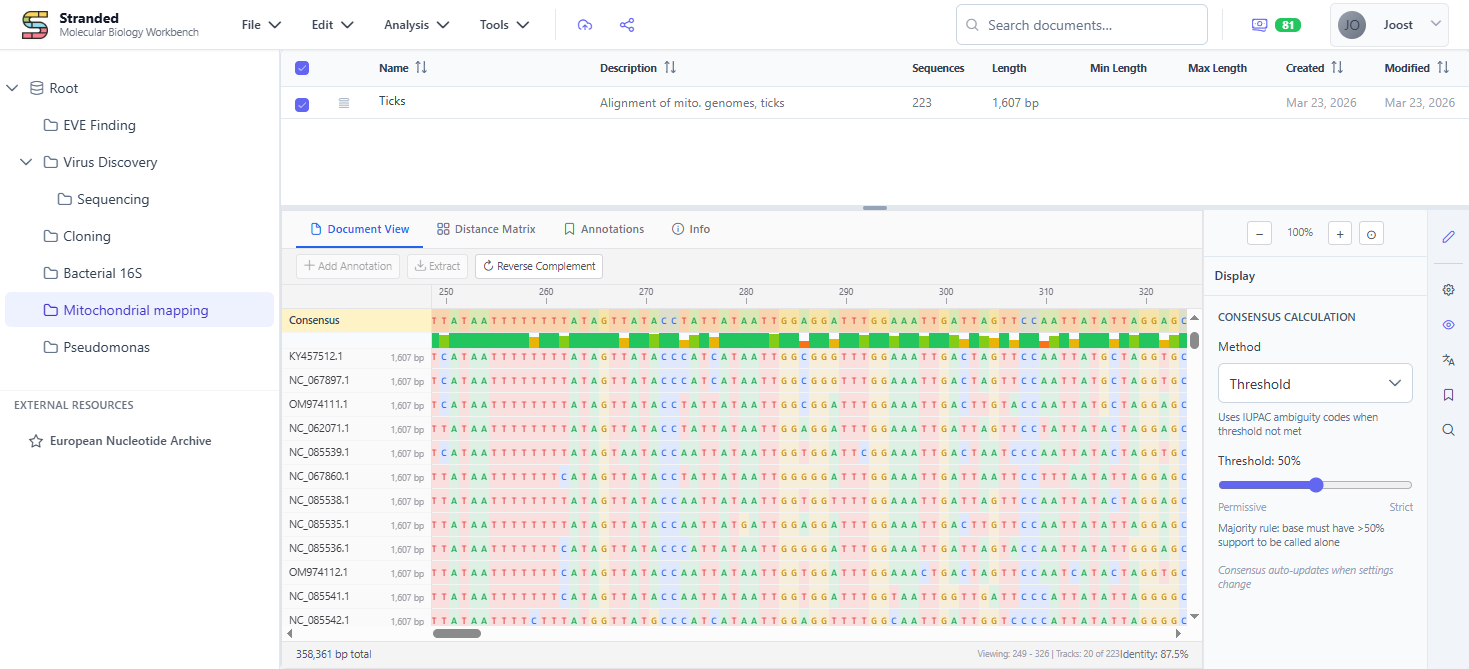
Align with popular tools direclty in-app - no command line needed. View consensus tracks, conservation scores, and color-coded residues. Edit gaps, adjust boundaries, and annotate directly within the alignment grid. Pairwise similarity matrices are computed automatically alongside every alignment.
04 - Assembly
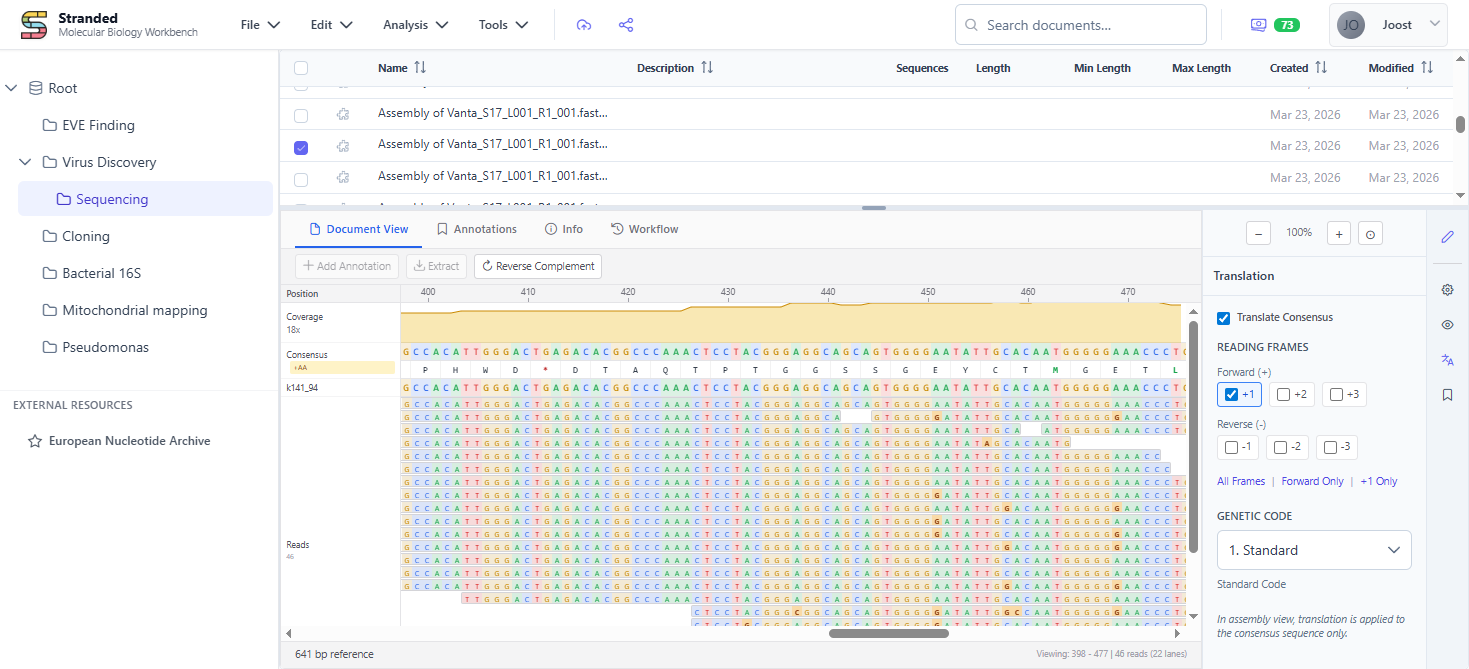
Assemble reads entirely in-app - both short- and long-read pipelines are supported, no local compute needed. Map reads to a reference with coverage graphs, variant overlays, and contig navigation. Inspect individual reads, view mismatches, and navigate to regions of interest. Alrady have assemblies? No problem, BAM imports are built right in.
05 - Annotations
Create, edit, and manage annotations such as - gene names, products, qualifiers, and other genetic features. All annotations render as synchronized tracks across every view. Auto-detect open reading frames with configurable parameters across all six reading frames. Design primers with our built-in mapping tool - visualize binding sites and predicted amplicons directly on your sequences.
--}}
06 - Phylogenetics
Perform phylogenetic analysis on your alignments, model-testing, maximum likelihood, and boostrapping, no problem! Use our powerfull built-in tree editor to zoom, reroot, collapse and highlight clades. We also provide recombination detection and visualization in an iteractive viewer, publication-ready, and exportable.
07 - Export
Checkout your data in common formats; FASTA, GenBank, Nexus, Newick, or generate password-protected share links for collaborators. Your data is never locked in.
08 - Provenance
Every result in Stranded knows where it came from. Open any document and see the exact workflow that produced it, which sequences were used as input, what parameters were set, and how long it took. Reproducibility is built in - not bolted on.
// no local compute
Workflows run on our servers, not on your computer. Pick your input, adjust a few options that come with sensible defaults, and click Run. The result is saved to your project when it is ready, together with the workflow and parameters that produced it. There is nothing to install, and you don't need a powerful machine.
// pricing
Simple pricing, no lock in, paid per month. Cancel any time.
How plans and tokens work →** The Student plan is for individuals currently enrolled in an active degree program.
** API access will be available from ~Q2 2027.
// faq
Stranded is a browser-based molecular biology workbench for sequences (including high-throughput sequencing such as Illumina and Oxford Nanopore data), Sanger chromatograms, alignments, assemblies and phylogenetic trees. It is made by VerCan ApS in Copenhagen, Denmark, and hosted in the EU.
Students, academic and government researchers, and commercial teams who work with sequence data. It is particularly usefull for those who have to visually inspect, verify and analyze sequence data.
No. Stranded runs in your web browser, and updates are applied automatically. We support most modern browsers.
No. Alignments, assemblies, tree building and other analyses run on our servers, not on your computer. You start a workflow, and the result appears in your project when it is ready.
Alignment: MAFFT and ClustalW. Phylogenetics: IQ-TREE 3, SimPlot and BootScan. Sanger: Birra and MIRA. Read QC and trimming: FastQC, NanoPlot, fastp, fastplong and NGmerge. Demultiplexing: Cutadapt. Mapping: Bowtie2 and minimap2. De novo assembly: MEGAHIT and MetaMDBG. Amplicons: 16S, 18S and ITS analysis. Clustering: MMseqs2. Annotation: ORF finder, primer and probe site finder, and BLAST-based annotation transfer.